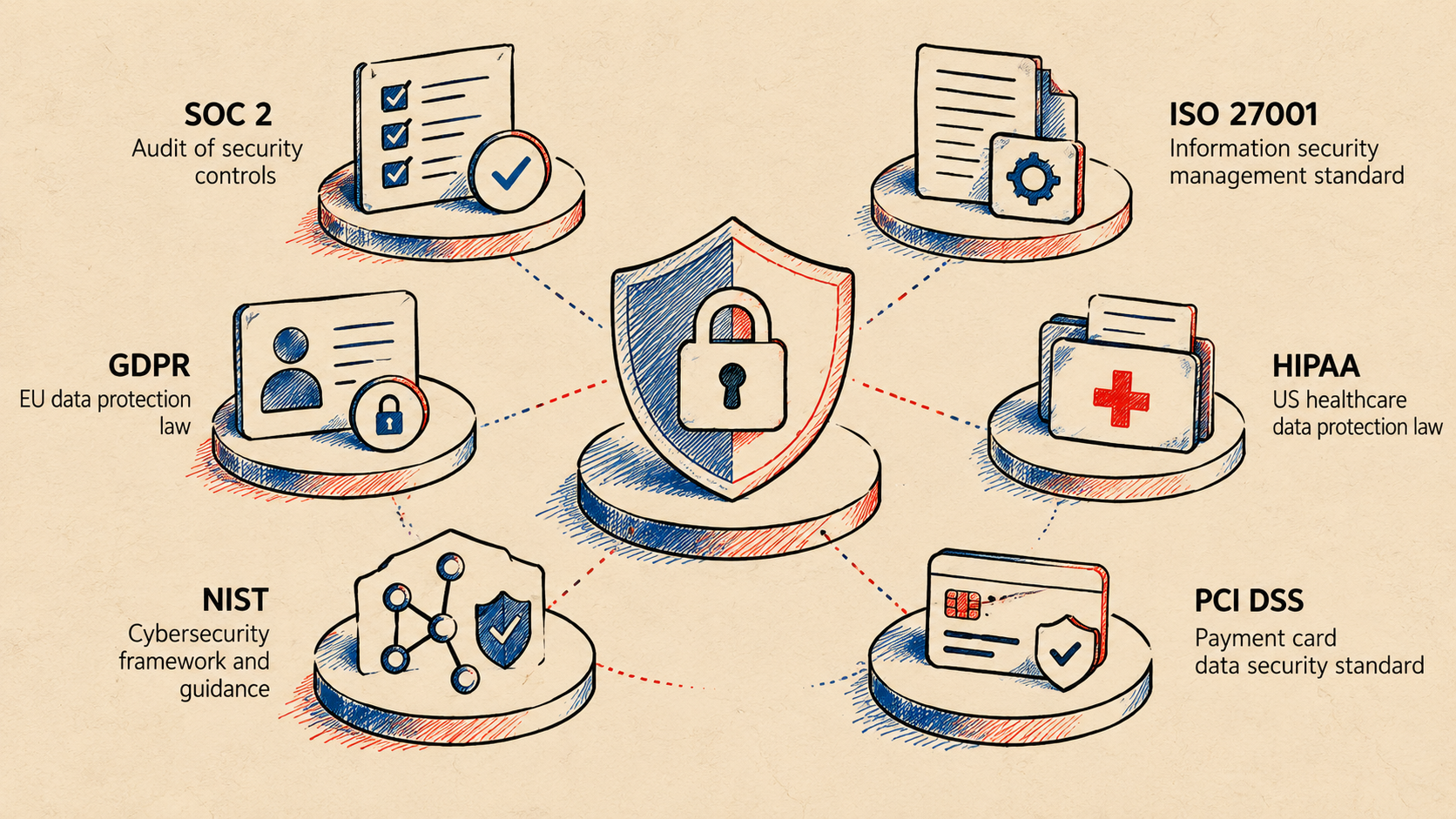
Organizations collect and handle a lot of sensitive information: customer details, passwords, financial data, medical records, payment information, employee data, and more. Governments, industries, and customers therefore expect companies to have rules and controls in place to protect that information.
That's where SOC 2, ISO 27001, HIPAA, GDPR, PCI DSS, and NIST come in.
They are different frameworks, standards, laws, and guidelines related to information security, privacy, and data protection. They don't all serve the same purpose:
Some are laws that organizations must follow when they apply.
Some are security standards that organizations can implement and become certified against.
Some are audit frameworks used to demonstrate that security controls are working.
Some are guidelines/frameworks that help organizations manage cybersecurity risk.
Some focus on a particular type of information, such as health data or payment-card data.
The goal behind all of them is broadly similar:
Make sure organizations understand the risks around information, protect data appropriately, and have processes in place to prevent, detect, and respond to security and privacy problems.
The important thing is to understand what each one actually is, what it protects, who it applies to, and why a company would care about it.
SOC 2
What it is: An independent audit of a company's controls around security and handling customer information.
In simple terms: “Prove that you have good security controls, and prove that they're actually working.”
Common in: SaaS, cloud, and technology companies.
Example: An auditor checks whether a company properly manages employee access, MFA, backups, security incidents, monitoring, etc.
Important: SOC 2 is an audit/report, not a law.
Easy way to remember: SOC 2 = prove your security controls work.
ISO 27001
What it is: An international standard for managing information security.
In simple terms: “Create a proper, organized system for identifying and managing security risks.”
It covers things like access control, policies, incident response, risk management, suppliers, physical security, and business continuity.
Companies can become ISO 27001 certified through an audit.
Easy way to remember: ISO 27001 = build and manage a formal security program.
HIPAA
What it is: A US federal law concerning protected health information.
In simple terms: “If you're covered by US healthcare privacy rules, you need to protect people's medical information.”
It deals with privacy, security, access to health information, disclosures, and breach notification.
Applies to certain healthcare organizations and their business associates.
Important: It's not really a “HIPAA certification.”
Easy way to remember: HIPAA = protect US healthcare information.
GDPR
What it is: An EU data-protection law.
In simple terms: “If you're handling people's personal data in situations covered by GDPR, you need to protect it and respect people's rights over it.”
It covers things like:
What data you collect
Why you collect it
How long you keep it
Who you share it with
Security
Data-access and deletion rights
Certain requirements around consent and data breaches
Easy way to remember: GDPR = protect people's personal data and respect their data rights.
PCI DSS
What it is: A security standard specifically for payment-card information.
In simple terms: “If you're involved in handling credit/debit card data, secure it properly.”
It covers things like encryption, access controls, vulnerability management, monitoring, and security testing.
Particularly relevant to merchants, payment processors, and companies handling cardholder data.
Easy way to remember: PCI DSS = protect payment-card data.
NIST
What it is: A collection of cybersecurity standards, frameworks, and guidance published by the US National Institute of Standards and Technology.
In simple terms: “Here's a structured way to think about and manage cybersecurity.”
A famous example is the NIST Cybersecurity Framework, which organizes security around:
Identify
Protect
Detect
Respond
Recover
Important: NIST isn't one certification or one law.
Easy way to remember: NIST = a practical guide for managing cybersecurity risk.
The really simple version
SOC 2 → Prove your security controls work.
ISO 27001 → Build a formal security-management system.
HIPAA → Protect US healthcare information.
GDPR → Protect personal data and people's privacy rights.
PCI DSS → Protect payment-card information.
NIST → Use a structured approach to cybersecurity.
And they can overlap. A company might use NIST guidance, become ISO 27001 certified, undergo a SOC 2 audit, and still need to comply with GDPR, HIPAA, or PCI DSS depending on what data it handles.