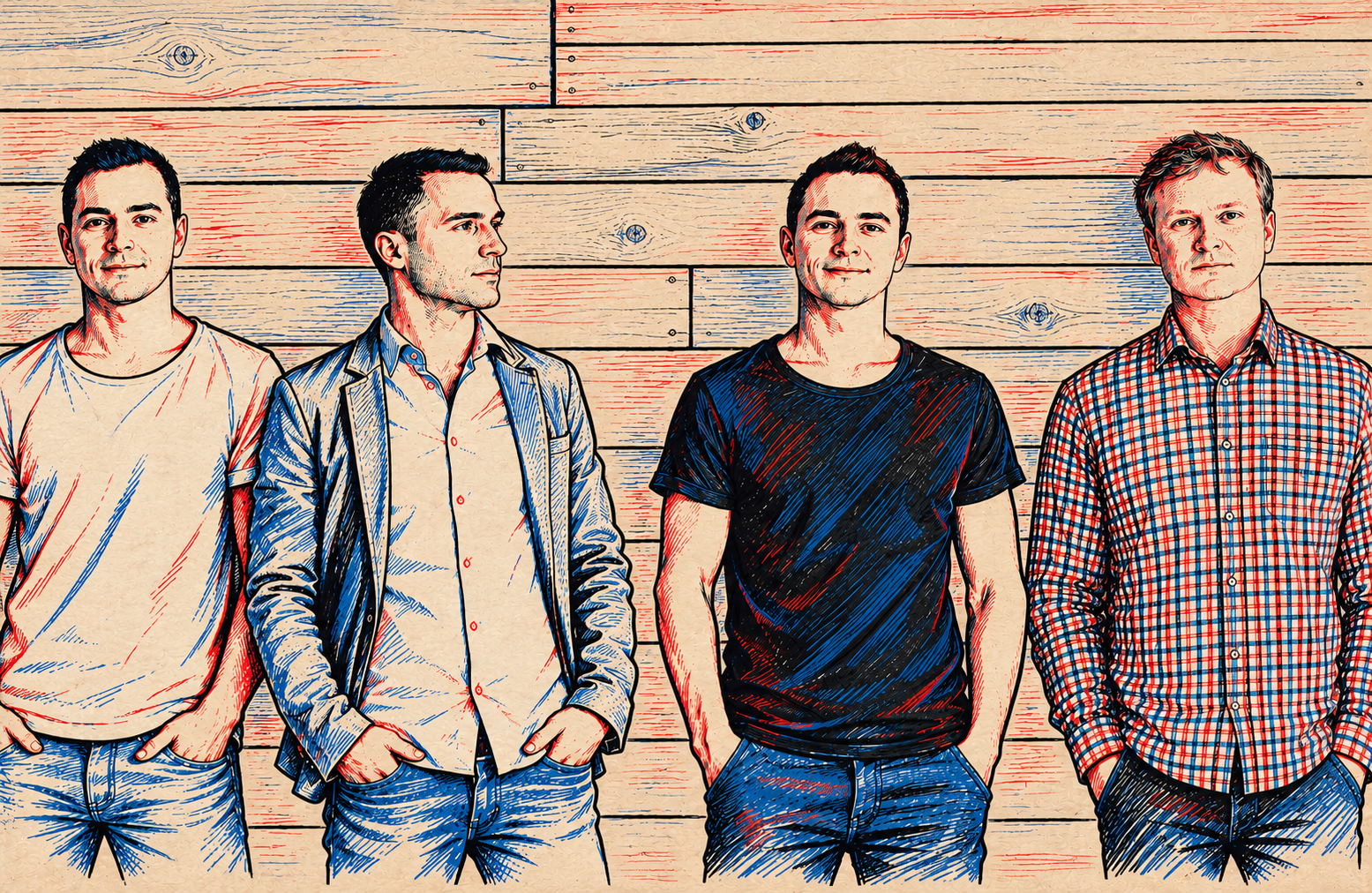
Andrew Sever, Peter Sever, Jacob Sever, Vyacheslav Zholudev.
Sumsub is a London-founded identity verification, fraud prevention and compliance technology company. Founded in 2015, the company has evolved from a relatively focused KYC provider into a broader “trust infrastructure” platform covering identity verification, Know Your Business (KYB), AML, fraud prevention, transaction monitoring and reusable digital identity.
The company has an unusual origin story. Its founders initially worked on technology designed to detect whether digital images had been manipulated. That project struggled commercially, but the underlying technology led them toward a more commercially valuable question: how can an online business determine whether a person is genuinely who they claim to be? This became the foundation for Sumsub’s identity-verification business.
Sumsub’s growth was helped substantially by the cryptocurrency and ICO boom beginning around 2017, when thousands of online businesses suddenly needed scalable KYC infrastructure. The company subsequently expanded into fintech, marketplaces, transportation, gaming, trading and other regulated or fraud-sensitive industries.
The founding team is also unusual: three of the founders are brothers, including a pair of twins, alongside CTO and co-founder Vyacheslav Zholudev, who holds a PhD in computer science. CEO Andrew Sever has a background in theoretical physics.
Sumsub raised a $6 million Series A in 2020 and a $30 million Series B in 2022. Dealroom records the 2022 round at a $120 million valuation.
In 2026, Sumsub joined the World Economic Forum’s Unicorn Community. WEF defines this community around privately held companies valued above $1 billion. This provides a strong indication that Sumsub has subsequently reached unicorn status, although the company’s precise current valuation is not publicly disclosed in the sources reviewed.
The company’s current strategic direction is broader than conventional KYC. Its stated ambition is to provide an AI-powered trust infrastructure layer capable of determining not only who a customer is, but also whether a customer, business or transaction should be considered trustworthy.
COMPANY OVERVIEW
Company: Sumsub, originally Sum and Substance
Founded: 2015
Headquarters: London, United Kingdom
Industry: RegTech, identity verification, fraud prevention and compliance
CEO: Andrew Sever
Co-founders: Andrew Sever, Peter Sever, Jacob Sever and Vyacheslav Zholudev
Core products: KYC, KYB, AML, fraud prevention, transaction monitoring and digital identity
Publicly disclosed funding: At least $36 million
Series A: $6 million in 2020
Series B: $30 million in 2022
Reported 2022 valuation: $120 million
2026 status signal: Member of the World Economic Forum Unicorn Community
Sumsub currently states that it serves more than 4,000 clients and processes verification for more than 2 million people per day. These are company-reported figures rather than independently audited metrics.
FOUNDING STORY
Sumsub’s origins are considerably different from those of a typical fintech company.
Before Sumsub, the Sever brothers experimented with several businesses, including web design, e-commerce and interactive mapping.
Around 2012, they began developing software capable of detecting whether digital images had been manipulated.
The original commercial application was insurance fraud detection. For example, insurers could potentially determine whether photographs submitted as part of a claim had been altered.
The idea proved difficult to commercialize.
The founders eventually recognized that the underlying problem was broader: digital businesses needed a reliable way to determine whether the person represented by an online document or photograph was genuine.
This led to the company’s pivot into identity verification and ultimately to the creation of Sumsub.
The history is strategically important because the company’s early work in image analysis and computer vision connects directly to its current capabilities in document analysis, facial recognition, liveness detection and fraud prevention.
Andrew Sever is Sumsub’s CEO and one of its three Sever-family founders.
His academic background is in theoretical physics. Prior to Sumsub, he held senior roles in IT companies and was involved in several entrepreneurial projects.
Peter Sever is Andrew’s twin brother. His background includes animation and computer graphics, which connects directly with the company’s early work in image analysis.
Jacob Sever is Peter’s twin brother. He has a background in product design, animation and computer graphics and previously served as Chief Product & Compliance Officer. He currently focuses on innovation.
Vyacheslav Zholudev is the company’s CTO and technical co-founder. He holds a PhD in computer science from Jacobs University in Germany and previously worked as a solution architect at ResearchGate.
According to Zholudev’s own account, he initially worked with the brothers on their image-forensics technology before joining the company full-time. He has described the founders as eventually giving him an equal share of the company.
The resulting founding team is unusual: theoretical physics, computer science, animation, computer graphics, product design and entrepreneurship.
That technical orientation is consistent with Sumsub’s evolution toward computer-vision-based identity and
That technical orientation is consistent with Sumsub’s evolution toward computer-vision-based identity and fraud technology.
COMPANY TIMELINE
2012 — ORIGINAL TECHNOLOGY
The founders begin developing image-forensics technology intended to detect manipulated images.
2015 — SUMSUB IS CREATED
The company pivots toward online identity verification and operates under the name Sum and Substance, later shortened to Sumsub.
2017 — CRYPTO BECOMES A MAJOR GROWTH CATALYST
The ICO boom creates a large number of cryptocurrency businesses that need KYC.
Sumsub uses the rapidly growing crypto sector as an important testing ground for its technology and compliance processes.
The company begins expanding beyond the initial crypto customer base.
2017 — EARLY EXTERNAL INVESTMENT
Sumsub reports that its seed financing included Flint Capital and Ilya Perekopsky.
2019 — KYB EXPANSION
The company begins building internal legal and compliance capabilities and expands from individual identity verification toward business verification.
This is an important transition from KYC vendor toward broader compliance infrastructure.
2020 — $6 MILLION SERIES A
Sumsub raises $6 million, with MetaQuotes leading the round.
2021 — RAPID INTERNATIONAL GROWTH
Sumsub reports substantial growth in revenue and customer numbers, with its business increasingly shifting toward international markets.
2022 — $30 MILLION SERIES B
Sumsub raises a $30 million Series B. Dealroom records a $120 million valuation associated with the round.
2022 — RUSSIA OPERATIONS CEASE
Following Russia’s invasion of Ukraine, Sumsub says it ceased its Russian operations in March 2022 and relocated affected employees.
2023–2024 — PRODUCT EXPANSION
The company broadens its offering into fraud prevention, transaction monitoring, Travel Rule compliance, deepfake detection, non-document verification and broader AML infrastructure.
Sumsub also expands its international presence.
2025 — REUSABLE IDENTITY
Sumsub launches its Reusable KYC / Sumsub ID proposition.
The concept is to allow verified identity information to be reused rather than requiring a consumer to repeatedly complete KYC procedures with every digital service.
2026 — AI-POWERED TRUST INFRASTRUCTURE
Sumsub positions the company beyond traditional identity verification, combining identity, business verification, AML, fraud signals, risk assessment and transaction monitoring into an integrated trust platform.
2026 — UNICORN STATUS SIGNAL
Sumsub joins the World Economic Forum’s Unicorn Community. WEF defines this community around privately held companies valued above $1 billion.
10 Things You Didn’t Know About Sumsub
Sumsub started as an “anti-Photoshop” company.
Before KYC, the founders were working on technology that could detect whether digital images had been manipulated. The original idea was aimed at problems such as insurance fraud.Three of the founders are brothers.
Andrew, Peter and Jacob Sever are brothers, and Peter and Jacob are twins. The fourth co-founder, CTO Vyacheslav Zholudev, joined the group from the technical side.The CEO studied theoretical physics.
Andrew Sever, Sumsub’s CEO, has a background in theoretical physics rather than traditional finance or business.Its CTO has a PhD in computer science.
Vyacheslav Zholudev holds a PhD in computer science and previously worked as a solution architect at ResearchGate.Crypto helped turn Sumsub into a serious business.
The 2017 ICO boom created a huge number of new crypto companies that needed KYC. Sumsub used that market to develop and scale its verification technology before expanding into other industries.The company wasn't originally called Sumsub.
It was founded as Sum and Substance. “Sumsub” became the shorter brand name.Sumsub has moved far beyond checking passports.
Today its platform can cover identity verification, KYB, AML screening, fraud detection, transaction monitoring, case management and reusable identity. The company is increasingly positioning itself as infrastructure for managing digital trust.A KYC check can involve much more than an ID document.
Sumsub can combine document verification, facial recognition, liveness, device and network information, AML databases and fraud signals. The idea is to assess both who someone is and how risky their behaviour appears to be.There is a serious security story behind the company.
Sumsub disclosed a security incident in 2026 involving unauthorized activity connected to a third-party support environment. The company said the incident did not compromise identity documents, biometric data or its production verification systems. It subsequently said it strengthened its controls.Sumsub is trying to become infrastructure that customers never notice.
The long-term opportunity isn't necessarily to become a famous consumer brand. Its technology can sit behind fintech apps, exchanges, marketplaces and other digital businesses. A customer may simply see “Verify your identity” without knowing that Sumsub is powering the process.
Takeaway
The whole Sumsub story can basically be reduced to:
“Can we tell if this picture is fake?”
→ “Can we tell if this person is real?”
→ “Can we tell if this person is trustworthy?”
That evolution explains a lot about why Sumsub has expanded from image analysis into KYC, fraud, AML and broader trust infrastructure.